Relieve Your C-Section Pain - No Drugs or Surgery
Adhesions often form after C-section, causing pain or tightness in the pelvis 1-4.C-section pain is often the result of scarring (adhesion formation) that occurs after the surgery. Designed to help the body heal, adhesions can cause ongoing pain or dysfunction, long after the surface scars have healed. Repeat surgery may remove some internal scars; yet, it can also cause new adhesions to occur, with new or ongoing pain and dysfunction. Clear Passage Physical Therapy® has over two decades of experience and success relieving C-section pain and dysfunction, without surgery or drugs.
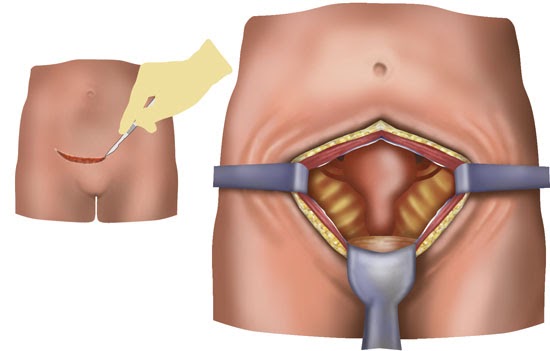
Cesarean section delivery (C-section) is the most common surgery among women in the United States.5 During a C-section, the physician cuts through the skin and abdominal walls, then cuts the uterus with an incision large enough to remove the newborn infant(s).
C-section is seldom a matter of choice for an expecting mother. Complications such as a breech baby or a vaginal birth that is not progressing may call for a C-section. Most physicians we know feel that a vaginal birth is safer and healthier for the mother and infant.
Abdominal adhesions refer to scarring or tissue repair that occurs anywhere in the abdomen. They form as the first step in the healing process after any surgery, trauma, infection, or inflammation. Wherever they form, adhesions join structures with strong glue-like bonds that can last a lifetime (see our general adhesions page for more detail.)
Pain and Dysfunction after C-Section
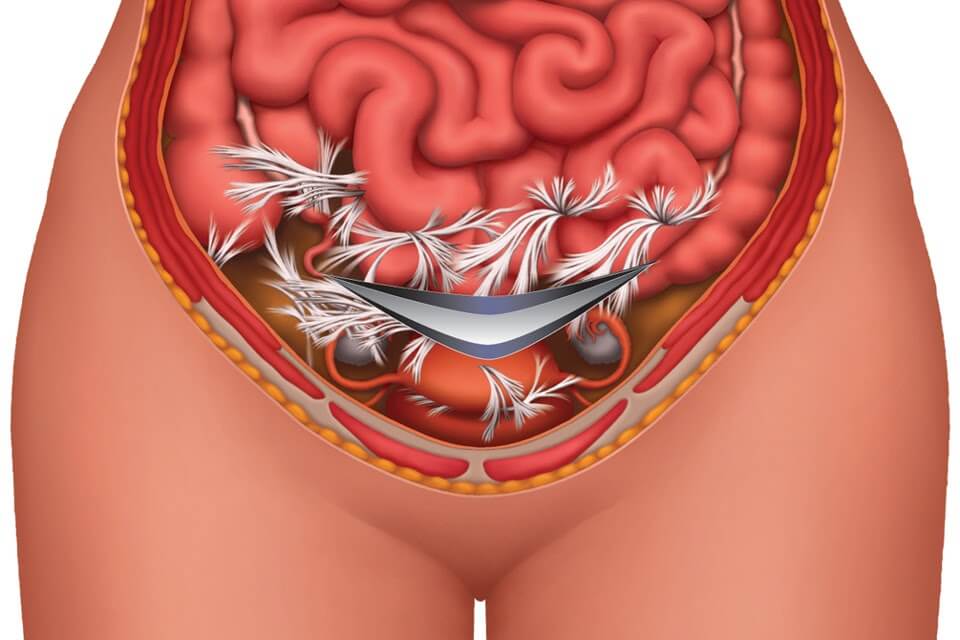
Adhesions can form wherever we heal from injury, surgery, or inflammation. Pelvic adhesions from c-section join structures with strong glue-like bonds that can cause pain.
According to a recent study in Birth (2008), 18 percent of women who underwent C-section surgery reported pain at the incision six months postpartum.6 An earlier study found that women who underwent C-sections were more likely to experience bowel problems than women with vaginal deliveries.7
In our patients, we find that dysfunction or pain after C-section is often due to post-surgical adhesions. As the first step in the healing process, tiny strands of collagen rush to the site that has been cut. There, they lay down in a random pattern to create the powerful bonds we call adhesions (see our general adhesions page for more detail). After a C-section, these adhesions remain in the body for life, as a permanent by-product of the surgery.
As adhesions repair surgical incisions, they can also attach structures to neighboring tissues. This can result in an uncomfortable pulling sensation or pain. When adhesions form in the delicate folds of the bowels, they can create pain or digestive problems such as diarrhea, constipation, or irritable bowel syndrome. In severe cases, these adhesions can cause bowel obstruction, a potentially life-threatening condition. C-section adhesions can also form in the delicate tissues of the reproductive tract, causing secondary infertility, pelvic pain or intercourse pain.
Surgery for C-section Pain
C-Section surgery generally causes adhesions to form. These adhesions can pull or spread into neighboring structures, causing c-section pain or dysfunction, including secondary infertility.
Until recently, lysis of adhesions was the only choice medical science offered to treat abdominal adhesions. This involves cutting or burning the abdominal adhesions under general anesthesia, via laparoscopy or laparotomy (open surgery).
While lysis of abdominal adhesions can be effective, surgery has two major drawbacks:
- it carries risks from anesthesia and infection, and
- despite the best skills of the finest surgeon, the body creates more abdominal adhesions as it heals from the surgery designed to remove them.
A study in Digestive Surgery showed that more than 90% of patients develop adhesions following open abdominal surgery and 55% to 100% of women develop adhesions following pelvic surgery.8 Another study reported that 35% of all open abdominal or pelvic surgery patients were readmitted to the hospital more than twice to treat post-surgical adhesions during the 10 years after their original surgery.5 Thus, abdominal surgery itself has been implicated as a major cause of adhesion formation and many patients become trapped in a cycle of surgery-adhesions-surgery – with no end in sight.
Treating Adhesions with the Wurn Technique
A patient is treated with the Wurn Technique®, a manual physical therapy which has been shown to reduce adhesions, decrease pain, and improve function, in peer-reviewed medical journals.
We know pelvic adhesions well. We faced this situation 20 years ago when the physical therapist director of Clear Passage Physical Therapy, Belinda Wurn, developed severe adhesions after surgery and radiation therapy to her pelvis. Unable to work due to the pain, and having seen the devastating and debilitating effects of pelvic adhesions in her own patients, she was determined to find a non-surgical way to address adhesions.
With her husband, massage therapist Larry Wurn, Belinda took a much deeper look at the etiology and biomechanics of adhesion formation. They found that the chemical bonds that attached each of the tiny collagen fibers to its neighbor appeared to dissipate or dissolve when placed under sustained pressure over time. With this knowledge, they developed the Wurn Technique® to unravel the bonds between the fibers that comprise adhesions.
When a patient who has undergone C-section comes to our clinic with pain, dysfunction or infertility, our physical therapists evaluate the uterus and pelvic and abdominal structures for areas of tension or restricted mobility. They pay particular attention to the areas around incisions. Considering the tendency of adhesions to spread, they then examine the entire body for areas of decreased mobility, tension, and pain. The “hands-on” work practiced at Clear Passage Physical Therapy clinics has been shown in peer-reviewed medical journals to reduce adhesions, decrease pain, and improve soft tissue mobility, without the risks of surgery or drugs.
- Morales KJ, Gordon MC, Bates GW Jr. Postcesarean delivery adhesions associated with delayed delivery of infant. Am J Obstet Gynecol. 2007;196(online):461.e1-461.e6.
- Fushiki H, Ikoma T, Kobayashi H, Yoshimoto H. Efficacy of Seprafilm as an adhesion prevention barrier in cesarean sections. Obstet Gynecol Treatment. 2005;91:557-561.
- Hamel K. Incidence of adhesions at repeat cesarean delivery. Am J Obstet Gynecol. 2007;196(online):e31-e32.
- Lyell DJ, Caughey AB, Hu E, Daniels K. Peritoneal closure at primary cesarean delivery and adhesions. Obstet Gynecol. 2005;106:275-280.
- http://www.womenshealth.gov/faq/hysterectomy.cfm
- Liakakos T, Thomakos N, Fine PM, Dervenis C, Young RL. Peritoneal Adhesions: Etiology, Pathophysiology, and Clinical Significance.Dig Surg. 2001; 18: 260-273. PMID 11528133.
- Ellis H, Moran BJ, Thompson JN, Parker MC, Wilson MS, Menzies D, McGuire A, Lower AM, Hawthorn RJ, O’Brien F, Buchan S, Crowe AM. Adhesion-related hospital readmissions after abdominal and pelvic surgery: a retrospective cohort study. Lancet Br J Med. 1999; 353: 1476-80. PMID 10232313.
Doctors comment on the Wurn Technique®
and the book Miracle Moms, Better Sex, Less Pain
"The Wurn Technique® makes sense: to put 'hands on' the problem and nurture the body's innate desire to heal from pelvic pain, hormonal imbalance, endometriosis, infertility, and related dysfunction."
Dr. Leslie Mendoza Temple, Medical Director, Integrative Medicine
Faculty: Northwestern University, Feinberg School of Medicine
"Women who suffer from chronic pelvic pain will benefit greatly."
Dr. Howard T. Sharp,President, International Pelvic Pain Society
Vice Chair, Department of Obstetrics and Gynecology
University of Utah School of Medicine
"Your work is a Godsend. Thank you for providing women all over the world with such a safe, natural, and effective therapy to enhance fertility and pelvic health."
Dr. Christiane Northrup, MD, Ob/Gyn physician
NYTimes best selling author of "Women's Bodies, Women's Wisdom"
"Mother-Daughter Wisdom" and "The Wisdom of Menopause"