Select your text size for this site here: Normal Text Medium Text Large Text

Chronic sciatic, sacroiliac, and hip pain

Chronic sciatic, sacroiliac, and hip pain can affect all aspects of a person’s life as well as the lives of families and friends. Sciatic pain that has persisted for more than three months is considered chronic. Symptoms may include back or leg pain when standing, walking or sitting, and prolonged morning stiffness. Some people report concurrent back or tailbone pain.

Treatment methods for sciatic and sacroiliac hip pain vary significantly. Many people do not obtain pain resolution after conservative treatment such as traditional physical therapy or medications. Chiropractic care may help temporarily, but unless we treat the strong underlying adhesions that pinch nerves or pull bony structures out of balance, pain resolution does not occur.

Most physicians agree that surgery is a treatment of last resort. While surgery can address adhesions and other mechanical problems, surgery also causes more adhesions to form. We suspect that new adhesion formation is one reason that some people do not obtain lasting pain relief after one or more surgeries. In fact, some people find their pain worsens after surgical intervention.

The mechanics of chronic sacroiliac, sciatic, and hip pain

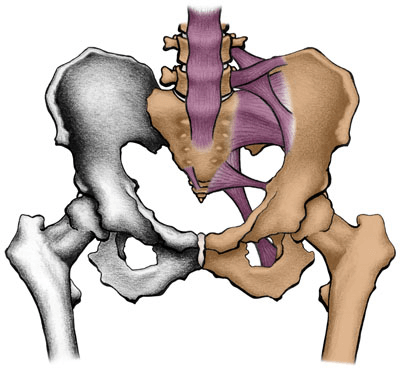
Posterior view of the low back, with support ligamentsPosterior aspect of the low back with support ligaments
Improper pelvic balance can cause
pain in the sacroiliac, sciatic, or hip

Two important elements in sacroiliac-sciatic-hip pain are biomechanical and soft tissue dysfunctions of the sacral joints. The sacrum is the body’s center of gravity and stability, simultaneously negotiating forces transferred from above and below it. A complex series of ligaments attach the sacrum to the two large pelvic bones (the ilia) at the sacroiliac joints. In doing so, they help provide a stable transition between the upper and lower body. The sacrum also forms a joint with the fifth lumbar vertebra, the lumbosacral junction, at the base of the spine.

The sacroiliac joints contribute significantly to the stability of the low back, and the lumbosacral junction contributes greatly to low back mobility. Together, these joints and their support ligaments support the entire body above the pelvis. Their function is vital with every step we take, as we transition our upper body weight from side to side. In fact, they represent significant structural and functional units when we walk, bend, lift, twist, or perform most activities of daily living.

We find a very high correlation among dysfunctions of the sacroiliac joints and pain in the sacrum, sacroiliac, or hips.

How structures are pulled out of balance

All of these structural elements are held together by collagenous soft tissues, such as fascia and ligaments (shown above). Collagen is extremely strong, with a tensile strength that has been measured at nearly 2,000 pounds per square inch. When bones and ligaments are in balance, we generally function well, without pain. Yet, if the pelvis, sacrum, and low back are out of alignment, adhesions can form, pulling these structural elements out of their normal balance. When this happens, instability and pain are the near-inevitable result.

Trauma, injury, surgery, or even years of poor posture can cause the body to create additional collagen as a response to inflammation. This new collagen forms glue-like adhesions, binding structures that should be mobile. Once the inflammation has passed, these collagenous adhesions remain in the body as a permanent by-product of healing. When they occur at the sacroiliac joints, or in the muscles of the buttocks or hip, pain may occur in any of these areas.

Herniated disks in the low back can cause pain into the hip or sciatic area, depending on which nerve root is irritated. Myofascial imbalances pulling the pelvis or hip out of proper alignment, and spasm of the piriformis muscle, deep in the hip/buttock, can irritate the sciatic nerve. This can cause pain from the hip down, sometimes to the knee or foot.

Clear Passage therapists are experts at treating all of these areas, freeing the pelvis, sacrum and hip of collagen fibers and adhesions that form during the healing process. This has been the focus of our work for most of the last two decades. As we decrease the collagenous bonds pulling the pelvis and low back out of alignment, mobility returns and pain generally decreases significantly. Freed of the glue-like adhesions, most patients find that they can move as they did years ago, with their pain significantly reduced or eliminated.

Our goal is to decrease your pain first, then restore your function. As pain begins to resolve, we work to restore alignment, balance, and mobility to the low back, sacrum, sciatic, and hip areas. As symptoms begin to resolve, we realign these structures with your legs (below) and your trunk (above) to allow your body to become more balanced, symmetrical, and functional. For more detailed information on how treatment works and how it feels, see “treatment philosophy” and “what treatment is like.”